Preissuance Submissions — Are They Worthwhile?

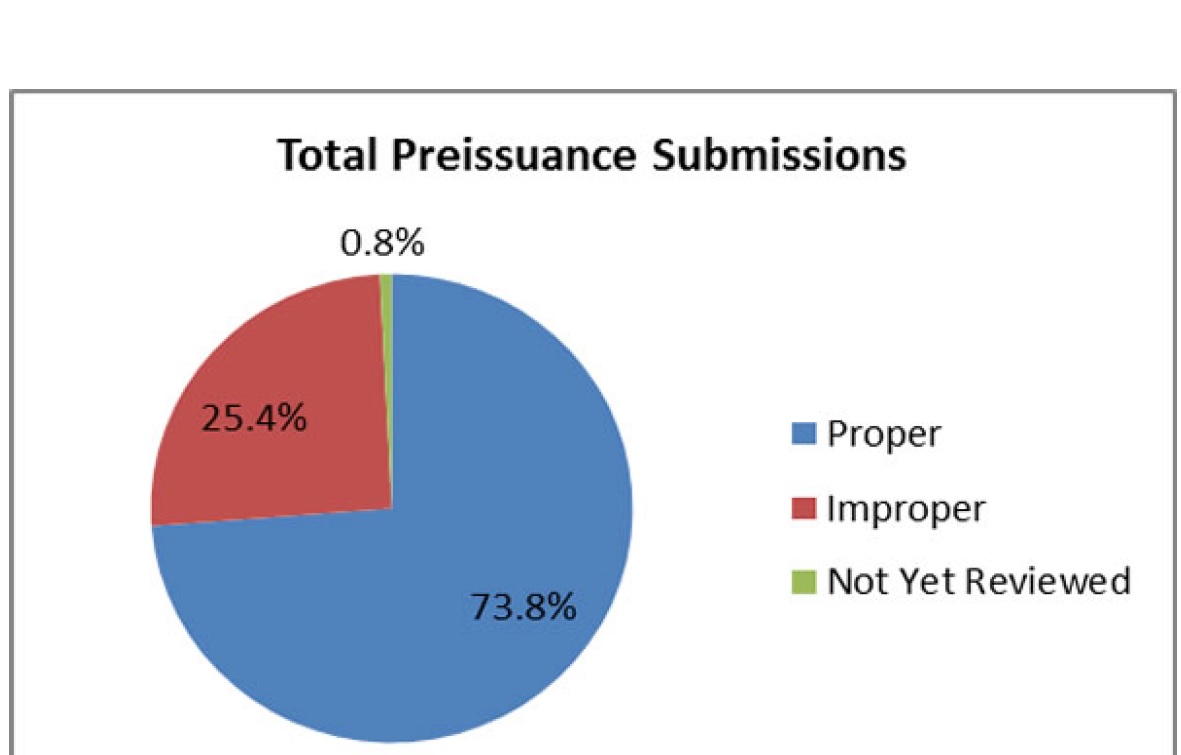
So far the USPTO reports a total of only 1382 submissions, about 25% of which were deficient.

Deficient

 Of the 1044 “proper” submissions, how many resulted in an Office Action relying upon the submitted art?  Just 12.5%.  Given that some interested party went to the effort and expense of making a submission, the fact that only 1 out of 8 is relied upon suggests that the Examining Corps is ignoring these submissions.

12

Curious about the prior art the USPTO is ignoring?  There are average of about 3.2 references per submission, which is likely due to the fact that there is no fee for a submission of three references or less.  28% of the submitted art are prior patents, 20% are prior published applications, 19% are foreign references, and 32% are non-patent literature.

Art

Supplemental Examination

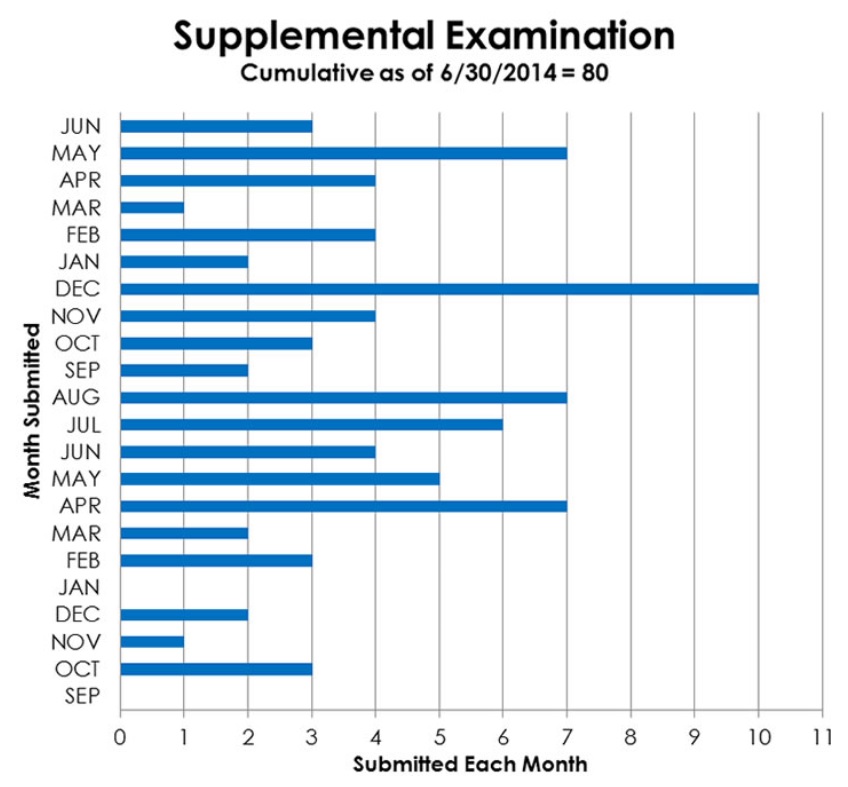
One of the few benefits to inventors in the AIA was the creation of Supplemental Examination, a procedure by which a patent owner could “cure” possible inequitable conduct.  However in two years, only 80 requests for Supplemental Examination have been filed.

20140630Supplemental

Of course the one reason why Supplemental Examination has languished is the Therasense’s but for materiality standard.  See, Therasense v. Becton Dickinson 99 U.S.P.Q. 2d 1065, 1074 (Fed. Cir 2011).  After Therasense,  If the invention is not found unpatentable over the reference, then that reference is not material (of course even if the patent survives the litigation, it might still be found unpatentable over the reference under the Patent Office’s lower evidentiary standard.

Of course there are other ways to commit inequitable conduct besides failing to disclose material prior art, such as false claim of small entity status (Outside the Box Innovations v. Travel Caddy), false statements regarding late payment of maintenance fees (Network Signatures, Inc. v. State Farm Mut. Auto. Ins. Co.), false statements in supporting declarations  (eSpeed v. Brokertec); failure to disclose the relationship between the declarant and the applicant (Ferring B.V. v. Barr Laboratories, Inc.).

With just 80 takers in over two years, Supplemental Examination seems like a solution in search of a problem.


Monkey Business Teaches an Important Copyright Lesson

There has been a lot of press recently about nature photographer David Slater’s claim of copyright in a “selfie” taken by a macaque monkey that picked up Slater’s camera and began snapping hundreds pictures.  The selfie, taken by a crested black macaque (Macaca nigra) in an Indonesian forest in 2011, found its way to the Wikipedia Commons website.

Macaca_nigra_self-portrait

To be copyrightable, a work must be the result of human authorship.  Emile Borel’s infinite monkeys at infinite typewritters might create a Shakespeare play, but it would not be copyrightable, and neither is a macaque selfie.

Slater’s monkey business is an important reminder about the importance of authorship to the ownership of copyright rights.  Works prepared by an employee in the scope of their employement are works made for hire, and the employer is considered the author and the owner of the work.  However with the exception of certain specified types of works created pursuant to a prior written agreement, the owner of a copyrightable work is the author.  This means that merely hiring and paying an independent contractor does not transfer ownership of the copyright in their work product, a critical lapse for someone who wants to modify (prepare derivatives of), or reproduce or distribute copies of, the work.  It’s also important to remember that while co-author of a copyrighted work can generally do whatever he or she wants with the jointly created work, each co-author but has to account to the other co-owners for the use of the co-owned work, and not necessarily in proportion to the contributions of the co-authors.

Whenever a non-employee is engaged to create a work  or contribute to a work, have a writen work-made-for-hire agreement (if appropriate), or an assignment.  Otherwise you may not be able to do what you want with that work.


What is Intellectual Property?

In Energy Recovery, Inc. v. Hague, [2013-1515] (March 20, 2014), Judge Wallach and the Federal Cricuit gave a definition.  In 2001, Hauge was ordered to assign all intellectual prioperty rights in pressure exchangers to Energy Recovery.  Years later, Hague was in the business of making pressure exchangers, and Energry Recovery moved for a contempt citation,arguing that he was using Energy Recovery’s technology.  Hague argued that he did in fact assign all of the intellectual property as required,  The district court found that Hague violated the letter and spirit of the agreement, but the Federal Circuit disagreed.    The Federal Circuit Hague was required to transfer intellectual property rights, and found that nothing prohibited Hague from using any manufacturing process, distinguishing between the underlying technology and the rights protecting the technology.  The Federal Circuit said that Hague may be infringing the assigned patents or trade secrets, but he is not in contempt of the order.

Don’t Forget About Virtual Patent Marking

One of the actual benefits of the AIA to inventors and patent holders was the creation of virtual patent marking.  Virtual patent marking allows the patent owner to mark its products by posting the patent information on a website, rather than on the product itself.  Virtual patent marking allows the patent owner to quickly add new patents as they are issued thereby preserving the ability to collect damages for infringements before suit is filed.  Virtual patent marking also allows patent owners to remove patents as they expire or their scope changes, thereby avoding liability for false patent marking.

35 U.S.C. 287 requires:

Patentees, and persons making, offering for sale, or selling within the United States any patented article for or under them, or importing any patented article into the United States, may give notice to the public that the same is patented, either by fixing thereon the word “patent” or the abbreviation “pat.”, together with the number of the patent, or by fixing thereon the word “patent” or the abbreviation “pat.” together with an address of a posting on the Internet, accessible to the public without charge for accessing the address, that associates the patented article with the number of the patent, or when, from the character of the article, this can not be done, by fixing to it, or to the package wherein one or more of them is contained, a label containing a like notice.

A patent owner can thus take advantage of this method of marking by putting a simple reference to the website on the product or, if appropriate, the product package:

Patent: www.company.com/patents

Pat.: www.company.com/patents

The website must “associate” the patented article with the number of the patent.  This can be done in a number of ways.  Some websites list the products in a table with the corresponding patent numbers.  See, for example Tivo’s site: http://www.tivo.com/legal/patents or Symantec’s site: http://www.symantec.com/about/profile/policies/virtual_patent_marking.jsp or Rapidscan’s site:  Other websites provide an index with links to seprate product pages.  See, for example, Abbott’s site: http://www.abbott.com/patents/vision-technologies.htm.  Still other webpages link to a single or to multiple .pdf listings.  See, for example, Bunn’s site: http://www.bunn.com/pdfs/misc/BUNN_Patent_List.pdf; Hill-Rom’s site: http://www2.hill-rom.com/usa/PDF/Patent_20120609.pdf, or Kimberly Clark’s site: http://www.kimberly-clark.com/ourcompany/innovations/patents.aspx.  Finally, some websites provide a searchable index.  See, for example, St. Jude Medical’s site: http://patent.sjmneuro.com/Public.


Ownership of Inventions

A critical component of IP Management is the acquisition of IP.  It is therefore appropriate that the inaugural post of this blog addresses acquiring ownership of inventions — in this case employee inventions.  An employer does not automatically own the inventions or its employees merely by virtue of the employer/employee relationship.  The employer only owns inventions that the employee has agreed to assign.  Sometimes this agreement is implied, for example when the employee is specifically hired to invent or is later assigned the task of inventing.  However, most times agreement is express.  Such an agreement can be oral, but as the saying goes, oral contracts aren’t worth the paper they are printed on.  An agreement with an employee to assign inventions should be in writing.

What should this written agreement say?  After Board of Trustees of the Leland Stanford Junior University v. Roche Molecular Systems, Inc., 583 F.3d 832, 842 (Fed. Cir. 2009), we know that an agreement to assign, is just that — an agreement to do something in the futureSuch an agreement can be trumped by an automatic assginment.  Thus is seems prudent to combine a promise to assign with a present assignment:

I agree to assign, and hereby do assign, to Employer all right, title, and interest in and to the Inventions.

Of course, this leaves open the question of what is an “Invention,” but that is a topic for another pose.