Timing is Everything

In Trieme Medical, LLC v. Angioscore, Inc., [2015-1504] (February 5, 2015) the Federal Circuit reversed the dismissal of Trieme’s complaint to have its assignor, Dr. Lotan, named as an inventor of Angioscore’s patents.

Lotan worked as a consultant for Angioscore, and had signed a consulting agreement with a Section 9(a) that gave Angioscore a license to any preexisting inventions made by Dr. Lotan:

(a) Inventions Retained and Licensed. Consultant has attached hereto, as part of Exhibit C, a list describing all inventions, original works of authorship, developments, improvements, and trade secrets which were made by Consultant prior to the date of this Agreement (collectively referred to as “Prior Inventions”), that belong solely to Consultant or belong to Consultant jointly with another and that relate to any of the Company’s current or proposed businesses, products or research and development; or if no such list is attached, Consultant represents that there are no such Prior Inventions. If, in the course of providing the Services, Consultant incorporates into a Company product, process or machine or into any Invention (as defined below), a Prior Invention owned by Consultant or in which Consultant has an interest, the Company is hereby granted and shall have a non-exclusive license (with the right to sublicense) to make, have made, copy, modify, make derivative works of, use, sell and otherwise distribute such Prior Inventions as part of or in connection with such product, process, machine or Invention.

and a Section 9(b) that gave Angioscore ownership of any inventions made during the term of the agreement:

(b) Assignment of Inventions. Consultant agrees to promptly disclose to the Company and hereby assigns to the Company, or its designee, all right, title and interest in and to all inventions, original works of authorship, developments, concepts, know-how, improvements or trade secrets, whether or not patentable, that Consultant may solely or jointly conceive or develop or reduce to practice during the term of this Agreement that relate to the Services (collectively referred to as “Inventions”).

Angioscore’s problem was that while the agreement was executed on May 1, 2003, Dr. Lotan actually began working before May 1, 2003, and the results of such pre-agreement work was not assigned to Angioscore.

The Federal Circuit could not determine on the sparse record of the motion to dismiss, whether or not the agreement transferred all of Dr. Lotan’s rights to Angioscore, or whether he retained some ownership based upon his pre-agreement work that he could validly transfer to Angioscore.  Angioscore may still prevail, but this case highlights the importance of knowing when a consultant or other inventor began working on the invention, and making sure that all rights, including those created before the execution of the agreement, are properly addressed.

Share and Share Alike? Not so fast.

The joint ownership of patents is governed by 35 USC 262:

In the absence of any agreement to the contrary, each of the joint owners of a patent may make, use, offer to sell, or sell the patented invention within the United States, or import the patented invention into the United States, without the consent of and without accounting to the other owners.

What this means, contrary to the likely expectations of the joint owners, is that any co-owner can do whatever he or she pleases with the patent, without accounting to the others.  The carefully crafted percentages that the owners allot themselves make no difference — a 1% owner can do whatever a 99% can do.

The solution to this potential problem is found in the first line of the statute: “in the absence of any agreement to the contrary.”  The peculiar effect of 35 USC 262 can be avoided by simply entering into an agreement, which the parties should consider recording to give public notice to the restrictions it places on the sale or license of patent rights.

What should be in a co-owners agreement depends upon the parties particular circumstances, but they should at least consider a provision governing the prosecution and maintenance of the patent applications and patents:

  • PARTY 1 and PARTY 2 agree to cooperate in the prosecution of any patent applications comprising the PATENT RIGHTS, and maintenance of any patents comprising the PATENT RIGHTS.

a provision regarding sharing the costs:

  • PARTY 1 and PARTY 2 agree to share equally all costs of prosecuting any patent applications comprising the PATENT RIGHTS, and maintaining any patents comprising the PATENT RIGHTS.

a provision restricting the individual exploitation of the patent applications and patents:

  • PARTY 1 and PARTY 2 agree to only exploit or license the PATENT RIGHTS jointly, and each agrees not exploit or license the PATENT RIGHTS without the agreement of, and participation of, the other, and further that any attempt by one of them to do so without the agreement of and participation of the other is void ab initio. PARTY 1 and PARTY 2 agree to share equally the costs of and proceeds from the joint exploitation and licensing of the PATENT RIGHTS.

and because such agreements can result in deadline, some provision addressing what happens if one party is unwilling or unable to pay its share of the costs:

  • In the event that one of the parties is unwilling and unable to pay his share of the costs of prosecuting a particular patent application comprising the PATENT RIGHTS, or maintaining a particular patent comprising the PATENT RIGHTS, and the other party is willing to and able to pay that share, then the party shall, promptly and without further consideration, assign all of its right, title, and interest in and to the particular patent application or particular patent to the other party in sufficient time to prosecute the application or maintain the patent, it being agreed that once a patent application or patent is owned by one person, it is no longer subject to this Agreement.

or if one of the parties wants to transfer its rights:

  • In the event that one of the parties (or their successor in interest) desires to sell all or part of its interest in the PATENT RIGHTS, that party shall first offer to sell that interest to the other party on the same terms and conditions, and hold such offer open for at least ten (10) business days.

Finally, because Federal Circuit has held that all owners are necessary parties, but an owner cannot be compelled to joint a suit, some provision regarding enforcement:

  • The parties agree to cooperate in the enforcement of the patent rights, including being named as a party in any agreed enforcement action, and sharing the costs and proceeds from any agreed enforcement action equally.


Should You or Any of Your C&D Team be Caught or Killed the Client will Disavow and Knowledge

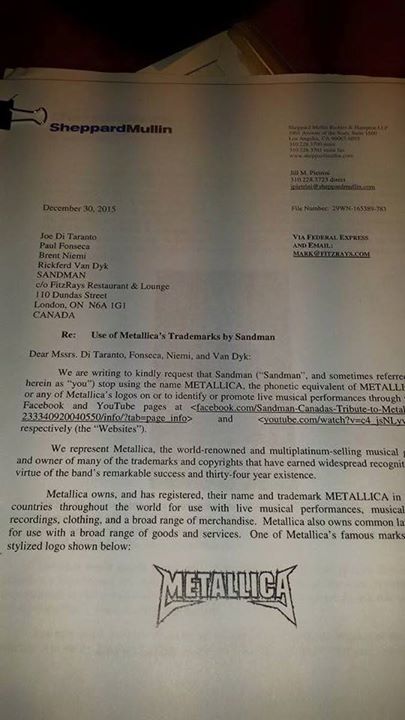
Late in December, the attorneys for Metallica sent a Cease and Desist letter to Sandman. a Metallica tribute band playing in Toronto.  Sandman lead, Joe Di Taranto, posted a copy of the letter on his Facebook page:

Metallica Letter

After the letter gained some attention, Metallica responded with supportive statements blaming lawyers and directing Sandman to “file the letter in the trash.”  Saying that “neither we nor our management were aware of” the letter until it surfaced online, Metallica said “Lucky for us, [Sandman] was kind enough to post it for us to see, and it turns out that we have a very overzealous attorney who sent this letter without our knowledge.”  Metallica added that “in the meantime, our attorney can be found at [San Francisco airport] catching a flight to go permanently ice fishing in Alaska.”

The sending of a cease and desist letter is a serious matter, whose consequences should be thoroughly reviewed among counsel and client.

Better Protection By Design

Design patents protect the aesthetic appearance of a product (or a part of a product). They are relatively easy and inexpensive to get, but are they worthwhile?

A design patent is a patent, meaning while the application is pending (typically about 20 months) the applicant can mark the product “patent pending,” and after the patent issues “patented.”  The design patent allows its owner to sue competitors for making, using, selling, or importing a product that is substantially the same as the patented design.  Substantially the same does not mean identical, and if the patent owner can show  the resemblance is such as to deceive such an observer and sufficient to induce him to purchase one supposing it to be the other, he or she has proven infringement.

A patent owner is usually entitled to an award of its lost profits, but no less than a reasonable royalty, however there is an alternative remedy for design patent infringement: the infringer’s profits. Moreover, this is the profit on the entire product.  Thus Apple was awarded Samsung’s entire profits on the phones found to infringe Applies design patents on the iPhone shell, not just the profits attributable to the shells (which were not sold separately).

Finally, a fifteen year design patent can be a stepping stone to perpetual trade dress protection, providing a period of exclusive use of the design needed to establish that the design has acquired “secondary meaning” and has become a protectable trade dress.

If a design patent makes sense in the United States, what about foreign protection.  Interestingly, while design patents are reasonably popular in the US, with more than 35,000 applications filed last year, design patents are even more popular in Asia,.  More than half a million design patent applications were filed in China last year (sixteen times as many as filed in the US), more than 65,000 were filed in South Korea, (nearly twice as many as filed n the US),and nearly 30,000 were filed in Japan (almost tying US filings):

  1. China (564555)
  2. S. Korea (64574)
  3. United States (35378)
  4. Japan (19738)
  5. EC (25745)
  6. Turkey (10251)
  7. India (9309)
  8. Iran (8864)
  9. Germany (7392)
  10. Australia (6597)
  11. Brazil (6590)
  12. Canada (5767)
  13. Russia (5184)
  14. UK (5084)
  15. France (4782)

Perhaps of more interest to US businesses is which countries are most popular with non-residents:

  1. China
  2. US
  3. EC
  4. Canada
  5. Japan
  6. Australia
  7. S. Korea
  8. India
  9. Russia
  10. Brazil

and in particular which countries are most popular with other U.S. filers:

  1. China
  2. Canada
  3. EC
  4. Australia
  5. Japan
  6. Brazil
  7. Mexico
  8. S. Korea
  9. India
  10. Russia

Design patents help round out an IP portfolio, but domestically, and abroad.

 

A Challenge to Inventorship Reveals Possible Issues Regarding Transfers of Ownership

In Shukh v. Seagate Technology, LLC, [2014-1406] (Fed. Cir. 2015), the Federal Circuit reversed summary judgment against Shukh claim to be named as a co-inventor for defendants, holding that Shukh’s reputational interest in being named an inventor gave him standing to challenge inventorship under 35 USC 256.

Shukh’s first argument was that Filmtec Corp. v, Allied-Signal, Inc., should be reversed.  Under Filmtec, Dr. Shukh’s assignment in the Employment Agreement of his ownership
and financial interests in his inventions conveyed legal in his inventions to Seagate, depriving him of standing to contest inventorship of the patent.  The Federal Circuit observed that  as a panel, it could not overrule that holding without en banc action — hardly a ringing endorsement of the immediate assignment doctrine of Filmtec.

While Filmtec has inspired us all to use the language “agree to assign, and hereby do assign.”  Perhaps we should do more.  An express statement that rights in any inventions vest immediately upon creation with the employer might provide some rights to the employer.  The employer might also incorporate assignment language in its invention disclosure statement:

I agree that all rights in the inventions disclosed herein belonged to the EMPLOYER from the moment they were created, and agree to assign, and hereby do assign any rights I may have in them to EMPLOYER,and authorize EMPLOYER to file a patent application thereon.  I further grant the the Chief Technology Officer of EMPLOYER a durable, irrevocable power of attorney to declarations, oaths, and other patent application papers, including assignments to EMPLOYER, if I am unable or unwilling to do so.

However, the Federal Circuit concluded that “concrete and particularized reputational
injury can give rise to Article III standing” to challenge inventorship of a patent, noting that “being considered an inventor of important subject matter is a mark of success in one’s field, comparable to being an author of an important scientific paper.”


When Help from A Vendor is Not So Helpful

The district court’s September 30 Order in Ethox Chemical, LLC vs. The Coca-Cola Company, 6:12-1682-KFM (D.S,C.2015) is an important reminder to pay close attention to the contributions made by vendors and consultants, and in particular to plan in advance for the possibility of such contributions.

Coca-Cola’s packaging group pioneered the use of polyethylene terephthalate (“PET”)
beverage containers.  One disadvantage of PET was that it is porous to gas, so the carbonation in beverages would gradually escape from the bottle.  Coca-Cola scientists identified an additive, BPO-1, that functioned as a gas barrier, and sought the assistance of several vendors including Ethox to make BPO-1 on a commercial scale.  Ethox determined that it it was not commercially feasible to use BPO-1, but one if its employees, Dr, Tanner, proposed PEM as an alternative.

Coca-Cola proceeded with a patent application on PET containers, and included PEM, which eventually resulted in the issuance of U.S. Patent No. 8,110,265.  However Coca-Cola did not include Dr. Tanner as a co-inventor.  Ethox and Dr. Tanner sued to have Dr. Tanner named as a co-inventor, and in the Order issued on September 30, the court agreed.  While adding Dr. Tanner as a co-inventor would not affect Coca-Cola’s access to the technology under 35 U.S.C. 262, it would affect Coca-Cola’s ability to block competitor from using the technology.  While the dispute is not yet over, and Coca-Cola may yet prevail, the dispute could have been avoided entirely with some advance planning.

Whenever a business deals with a third party who could potentially solve a technical problem it is facing, that business should address  the possibility upfront taking steps to secure access to the solution, and if desired secure exclusivity over the solution.  In addition, when preparing a patent application, the potential contributions of anyone who might have contributed to the invention should be vetted..


State Statute Restricting Assertion of Patent Infringement Not At Issue, So Remand to State Court Appropriate

Many of the states have passed legislation purporting to restrict a patent owner’s right to make accusations of infringement.  Some of these statutes seem to be of questionable validity, but we will have to wait for a determination.  In State of Vermont v, MPHJ Technology Investments, LLC, [2015-1310] (September 28, 2015), the Federal Circuit affirmed the district court’s remand back to state Court, finding that the Vermont Bad Faith Assertions of Patent Infringement Act (“BFAPIA”) had not (yet) been raised by the state.

The State of Vermont initiated an action under the Vermont Consumer Protection Act, 9 V.S.A. § 2453(a) for unfair trade practices and deceptive trade practices arising from MPHJ’s conduct in sending patent infringement warnings in the State of Vermont.  The district court found that Vermont was not seeking an injunction that requires MPHJ’s compliance with the Vermont Bad Faith Assertions of Patent Infringement Act (“BFAPIA”), 9 V.S.A. §§ 4195–99.. Given this conclusion, the Federal Circuit agreed that if the State
prevails on the merits in state court, it may not seek an injunction requiring MPHJ to comply with the BFAPIA.  The Federal Circuit found that because MPHJ relies
on the BFAPIA as its basis for removal under § 1442(a)(2), the necessary consequence of our decision is that we find no grounds for removal to federal court.


You Can’t Put Your Head in the Sand; Manage Employee Departures

Personalized User Model, LLP v. Google Inc., [2014-1841, 2015-1022] (August 18, 2015), has a number of valuable lessons to employers about handling employees and employee inventions.  In addition to lessons about present versus future assignments (see Prior Post), the Federal Circuits also explained the diligence required when an employee leaves.  As a defense to Personalized User Model’s infringement claims, Google tried to acquire the rights of the invention owned by SRI, the employer of one of the co-owners at the time of conception.  However, to assert these rights, Google had take the position that the employee breached its agreement to disclose and assign the invention, while the employee took the position that such a claim was barred by the statute of limitations.  Google argued that the statute of limitations was tolled because the breach was “unknowable” by SRI, but the Federal Circuit disagreed.

The Federal Circuit said that SRI knew the employee was leaving to immediately work at a start-up technology company. Considering the competitiveness of companies and relatedness of the technology, the employee departure was a “red flag” that should have generated further inquiry.  The Federal Circuit indicated that SRI should have conducted an exit interview, even if a disclosure would not have been forthcoming.  The Federal Circuit also said that SRI could have asked other employees and watch competitive patent filings.  The Federal Circuit said:

Employers do not need to track a former employee’s every movement for an indefinite period of time to look for potential claims, but there should be some basic level of diligence in looking after one’s interests.

The Federal Circuit said that whether this “basic” level of diligence is satisfied by evidence of a standard exit interview wherein the departing employee is asked if all contractual obligations have been met, or of inquiring unobtrusively about the employee’s new startup company, should be determined on a fact-specific basis.

An employer should consider:

  • Providing for an exit interview in its employee agreement (use a checklist that you get the employee to sign).
  • Requiring the employee to advise of subsequent employers.
  • Getting permission of the employee to contact subsequent employees (and avoiding a tortious interference claim).
  • Monitoring the patent applications published and patents issuing to the former employee and his/her new employer.


“I agree to assign and hereby do assign”

Personalized User Model, LLP v. Google Inc., [2014-1841, 2015-1022] (August 18, 2015), reminds us that an employee agreement will preferably include a immediate assignment of the employee’s inventions. Personalized User Model sued Google for patent infringement.  In the course of discovery, Google learned that the patented inventions were conceived while one of the co-inventors was employed by SRI.  In a move worthy of Harvey Specter and Mike Ross in Suits, Google attempted to acquire SRI’s rights in the invention.  Unfortunately for Google, the Federal Circuit agreed with the district court that the statute or limitations prevented Google from asserting a breach of contract action against the co-inventor.  The result likely would have be very different, if, instead of simply agreeing to assign inventions conceived during employment:

I agree to execute such documents, disclose and deliver all information and data, and to do all things which may be necessary or in the opinion of SRI reasonably desirable, in order to effect transfer of ownership in or to impart a full understanding of such discoveries, improvements and inventions to SRI.

the agreement provided that the inventions automatically belonged to SRI.  While one can forgive this lapse in an agreement drafted more than thirty years ago, today it is generally advisable to have an automatic assignment.  Several years ago in Board of Trustees of the Leland Stanford Junior University v. Roche Molecular Systems, Inc., 583 F.3d 832, 842 (Fed. Cir. 2009) the Federal Circuit explained that the language “agree to assign” is merely an agreement to assign in the future requiring a subsequent written instrument.  In contrast, the words “do hereby assign” have been construed as a current  assignment of future inventions.  See FilmTec Corp. v. Allied-Signal, Inc., 939 F.2d 1568, 1572-73 (Fed. Cir. 1991).  If SRI’s agreement had included a current assignment of future inventions, SRI would have had ownership rights to sell to Google, irrespective of any breach by the employee.

Personalized User Model is a great reason to review existing employee agreements, and to make sure that they include a current assignment of future inventions.  Of course, if your agreement does provide include a current assignment, you have to make sure that the rest of your paperwork is consistent.  Thus, rather than having the inventor subsequently execute an assignment of a particular invention, one should have the inventor execute a confirmation of the prior assignment of that invention.  Furthermore, if because of some business arrangement, a company want to assign rights to some third party, the company must do so itself (because of the automatic assignment), and an assignment from the employee would be ineffective to do so, because the rights had already been assigned to the company.  Board of Trustees of the Leland Stanford Junior University v. Roche Molecular Systems, Inc., 583 F.3d 832, 842 (Fed. Cir. 2009).


No Good Deed Goes Unpunished — Follow Company Policy Regarding Unsolicited Submissions

The Delaware Court of Chancery recently dismissed Joseph Alfred’s Complaint against the Walt Disney Company for its breach of implied contract resulting from Disney’s refusal to negotiate with Mr. Alfred for a license to Disney’s T-65 X-wing fighter plane and thereby stalling the next evolution of human transportation.  The crux of Mr. Alfred’s complaint, if there is one, is that Disney varied from its standard policy not to accept unsolicited proposals, and in so doing created an expectation in Mr. Alfred that his proposal would be accepted.

Alfred v. Disney P25

While such policies are often cited as being short sighted and stifling, they do in fact protect businesses from litigation, and a variance from such a policy invites trouble, as Mr. Alfred has proven.  Disney was able to get the suit dismissed in its early stages, but its doubtful that the Disney employees who participated in July 22, 2014, call had factored in the cost in both money and time, of taking the initiative with an unsolicited disclosure.