
In Versata Software, LLC v. Ford Motor Company, [2024-1140, 2024-1206, 2024-1234] (modified September 10, 2026), the Federal Circuit modified its May 2026, opinion, changing a single sentence. In determining breach of contract damages, an issue was Versata’s cost savings. The May 22 opinion said that: “And at no point did Ford claim that there were additional costs associated with the base license.” This was an over-statement, because the September 10 amended version says: “And at no point did Ford demonstrate that it was beyond dispute that there were additional costs associated with the base license.” The Federal Circuit changed the meaning of the sentence from a statement that Ford did not claim there were additional costs to a statement that Ford did not demonstrate that there were additional costs.
Inability to Identify Trade Secrets Dooms Misappropriation Claim
In Wilbur-Ellis Co. v. Gompert, No. 25-1577 (8th Cir. July 7, 2026), the Eighth Circuit affirmed the district court’s grant of summary judgment in favor of Wilbur-Ellis’s former employees, concluding that Wilbur-Ellis failed to adequately identify its trade secrets.
Wilbur-Ellis must have felt it had a good case. Several of its employees quit in August 2024, and within three days they were working for a competitor while still drawing their salaries from Wilbur-Ellis. A total of eleven employees left. At least two of the departing employees downloaded and accessed files stored on Wilber-Ellis devices during their last weeks of employment. The departing employees reset their devices before returning them to Wilbur-Ellis. Wilbur-Ellis acted without delay, suing two of the employees four days after they left the company alleging breach of the duty of loyalty, misappropriation of trade secrets under the federal Defend Trade Secrets Act (DTSA) and the Nebraska Trade Secrets Act (NTSA), and tortious interference with its business relationships, and adding two more employees within two weeks.
When ordered to disclose with specificity the trade secrets that were misappropriated, Wilbur-Ellis produced a six-page document that described its alleged trade secrets with phrases like “[d]ocuments and information regarding Wilbur-Ellis’s business and market strategy,” “[d]ocuments and information relating to Wilbur-Ellis’s customers,” and “nonpublic customer proposals, pricing and rebate data.”
The Eighth Circuit agreed with the district court’s observation that that Wilbur-Ellis “paint[ed] with a broad brush, never clearly and adequately identifying the ‘trade secrets’ at issue, let alone how they were used or misused or the damages reasonably attributable to each defendant.” The district court also stated that “Wilbur-Ellis’s reliance on broad terms, general descriptions, and repeated, non-specific references . . . do not suffice. Without more, much of the information it designates as trade secrets also appears to be public or unprotected.” The Eighth Circuit said that because we agree with the district court’s finding that Wilbur-Ellis “never clearly and adequately identif[ied] the ‘trade secrets’ at issue, let alone how they were used or misused,” we hold that it did not err in granting summary judgment on Wilbur-Ellis’s trade secrets claims.
Eliis-Wilbur certainly had trade secrets, and they very well may have been misappropriated. But, like many trade secret owners they simply were not prepared for the level of detail neccessary to adequately identify their trade secrets. Here is a ten-point plan for being prepared to successfully make a trade secret claim:
1. Maintain a Formal Trade Secret Inventory
The single most valuable thing a company can do is maintain a living trade secret inventory. The inventory should identify each trade secret, rather than merely categories of confidential information. For example, instead of “manufacturing process” the inventory should identify “Multi-stage catalytized reduction process for reducing sulfur impurities below 5 ppm using catalyst sequence A-B-C, operating temperatures of 180-195, . . .”.
The inventory should include:
- Name of trade secret
- Description
- Business purpose
- Why it is valuable
- Why competitors do not know it
- Persons with access
- Documents containing it
- Date created
- Updates
- Owner/business unit
- Security measures
2. Divide Trade Secrets into Individual Assets
Many companies identify trade secrets too broadly. Courts dislike descriptions like: “Our customer relationships.” Instead identify:
- pricing model
- discount formulas
- customer purchasing histories
- purchasing forecasts
- customer-specific technical requirements
- supplier cost information
- margin calculations
- manufacturing tolerances
- production scheduling algorithms
Each may be a separate trade secret.
3. Map Trade Secrets to Documents
Every trade secret should be tied to specific documents. For example, Trade Secret 1 is reflected in:
- Engineering Specification ENG-12
- CAD Assembly 3.1
- Laboratory Notebook 5. p. 45
- Git repository revision
- Manufacturing SOP 3
This later makes identification dramatically faster and easier.
4. Classify Information
Implement levels such as:
- Public
- Internal
- Confidential
- Highly Confidential
- Trade Secret
Employees should know what qualifies as merely confidential and what qualifies as a trade secret.
5. Mark Trade Secret Documents
Whenever practical, documents should be marked “CONFIDENTIAL” or CONFIDENTIAL – TRADE SECRET.” Although not legally required, consistent marking supports the argument that reasonable secrecy measures were employed.
6. Record Why Information is Secret
For each trade secret document, record:
- not publicly known
- independently developed over years
- cost to develop
- competitive advantage
- inability to reverse engineer
- limited employee access
Later these become litigation evidence.
7. Maintain Development Histories
Keep (securely):
- laboratory notebooks
- engineering notebooks
- Git history
- version histories
- project timelines
- design reviews
- invention disclosures
These establish originality and value.
8. Document Security Measures
Maintain records showing:
- NDAs
- employee confidentiality agreements
- vendor agreements
- password restrictions
- VPN controls
- encryption
- badge access
- visitor logs
- clean desk policies
- information security policies
- annual employee training
Reasonable secrecy measures are an essential element of a trade secret claim under both the federal and most state trade secret statutes.
9. Conduct Regular Trade Secret Audits
Periodically ask: “What information would hurt us if our largest competitor obtained it tomorrow?” and update the trade secret inventory.
10. Prepare Employee Departure Files
For employees with significant confidential access, maintain records of:
- systems accessed
- projects
- customer responsibilities
- confidential files used
- inventions worked on
- exit interview certifications
Judge Opposes Unopposed Motion for Preliminary Approval of Anthropic Settlement
On Sunday, September 8, 2025, Judge Alsup, issued an Order regarding the hearing for preliminary approval of the Anthropic settlement, expressing disappointment “that counsel have left important questions to be answered in the future.” The Order stated that the hearing will nonetheless go forward, and that everyone will work hard to make progress in person.
AI Training Moving Closer to Resolution
On June 23, 2025, the Northern District of California granted Anthropic’s motion for summary judgment that its training of its LLM Claude (and Claude’s predecessors) with plaintiff-authors works was a fair use. Bartz v. Anthropic PBC, Case No. 24-cv-5417, Doc, 231 (N.D. Cal. June 23, 2025). Specifically, Judge Alsup found that the use of plaintiffs’ books to train Claude and its precursors was “exceedingly” or “spectacularly” transformative and was a fair use under Section 107 of the Copyright Act. The court also held that the digitization of the books purchased in print form by Anthropic was also a fair use because all Anthropic did was replace the print copies it had purchased for its central library with more convenient space-saving and searchable digital copies for its central library — without adding new copies, creating new works, or redistributing existing copies. However, the court held that Anthropic had no right to use pirated materials (e.g. materials from pirated sources like Library Genesis and Books), and the creation of a permanent, general-purpose library was not itself a fair use excusing Anthropic’s piracy. Two days later, in Kadrey v. Meta Platforms, Inc. (Judge Chhabria, June 25, 2025), the court reached a similar determination that the use of copyrighted works is a fair use.
After these decisions, the parties in Anthropic negotiated a settlement of the pirating claims with these key terms:
- Anthropic will pay the Class at least $1.5 billion dollars, plus interest. With around 500,000 works in the Class, this amounts to an estimated gross recovery of $3,000 per Class Work.
- Anthropic will destroy the LibGen and PiLiMi datasets containing pirated works used in LLC training, after the expiration of any litigation preservation or other court orders.
- Anthropic will receive a past release only for conduct up to August 25, 2025, and excluding any claims (past or future) arising out of allegedly infringing outputs from the resulting AI.
Anthropic filed an UNOPPOSED MOTION FOR PRELIMINARY APPROVAL OF CLASS SETTLEMENT on September 5, 2025, and a hearing is scheduled for September 8, 2025. Presumably, Meta’s case will not be far behind.
Supreme Court affirms 100+ Year Period for Copyright Damages
In Warner Chappel Music, Inc., v. Sherman Nealy, [22–1078] (May 9, 2024), the Supreme Court finally clarified copyright’s 3-year statute of limitations (17 U. S. C. §507(b)), holding that a copyright plaintiff who timely brings a copyright infringement claim, can recover damages for the entire period of infringement, and not limited to the three year period before suit was brought.
Sherman Nealy and Tony Butler formed Music Specialist, Inc., which recorded and released one album and several singles, including the works at issue. Nealy went to prision, and Butler (unbeknownst to Nealy) entered into an agreement with Warner Chappell Music, Inc. to license the works. In 2018, following his second prison stint, Nealy sued Warner Chappell for copyright infringement, alleging that held the copyrights to Music Specialist’s songs and that Warner Chappell’s licensing activities (dating back to 2008) infringed his rights.
Warner Chappell argued that damages were limited to the 3-year period before suit was filed. The district court agreed, relying on a decision from the Second Circuit, and held that even when claims for old infringements are timely, monetary relief is “limited” to “the three years prior to the filing” of the action. The Court of Appeals for the Eleventh Circuit reversed, rejecting the notion of a three-year damages bar on a timely claim (assuming for the purposes of answering the certified question that all of Nealy’s claims were “timely under the discovery rule).
The Supreme Court granted certiorari on the question “whether, under the discovery accrual rule applied by the circuit courts,” a copyright plaintiff “can recover damages for acts that allegedly occurred more than three years before the filing of a lawsuit.” The Supreme Court found the answer in the Copyright Statute:
The text of the Copyright Act answers that question in favor of copyright plaintiffs. The Act’s statute of limitations provides in full: “No civil action shall be maintained under the provisions of this title unless it is commenced within three years after the claim accrued.” §507(b) . . . That provision establishes a three-year period for filing suit, beginning to run when a claim accrues—here, we assume, upon its discovery. And that clock is a singular one. The “time-to-sue prescription,” as we have called it, establishes no separate three-year period for recovering damages, this one running from the date of infringement.
The Supreme Court noted that Second Circuit’s contrary view, on top of having no textual support, was essentially self-defeating. On one hand, the court recognizes a discovery rule, thus enabling some copyright owners to sue for infringing acts occurring more than three years earlier, but with the other hand, the court takes away the value in what it has conferred, by preventing the recovery of damages for those older infringements.
Thus, a copyright owner could theoretically recover damages for activities extending back 100 years or more given copyrights term of the life of the author plus 70 years (the shorter of 95 years from first publication or 120 years from creation for anonymous work, a pseudonymous work, or a work made for hire). The Supreme Court, to the chagrin of the dissent, expressly did not decide whether the discovery rule (where the limitations period runs from when the copyright discovered the infringement or reasonably should have discovered the infringement) is the correct rule for applying the statute of limitations. The dissent forcefully argued against the Discovery Rule, which coupled with today’s decision, could result in 100+ years of copyright damages as the title of this post suggests, something that a statute of limitations should not allow.
Still Chasing A Buck?
Just over a year ago, on August 24, 2021, Spencer Elden sued the band Nirvana and related parties for child pornography for publishing his image on the cover of Nirvana’s iconic 1991 Nevermind Album..
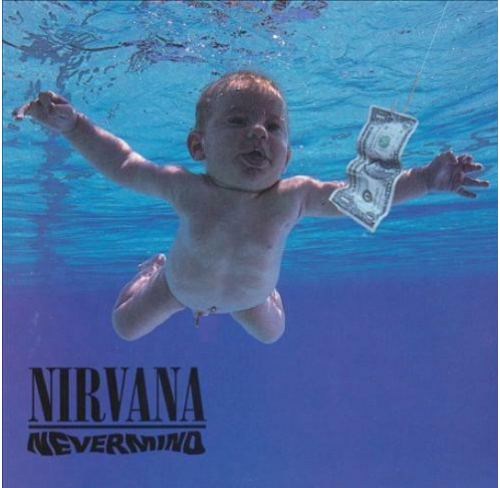
The Complaint alleged child pornography (18 USC 2255(a).and 1595), Negligence, violation of Cal. Civ. Code 1708.85, Intrusion into Private Affairs, and Invasion of Privacy. Elden alleged “extreme and permanent emotional distress with physical manifestations, interference with his normal development and educational progress, lifelong loss of income earning capacity, loss of past and future wages, past and future expenses for medical and psychological treatment, [and] loss of enjoyment of life.”
On September 3, 2022, Judge Olguin dismissed the claim, ruling that Elden waited too long to file the suit, citing a 10-year statute of limitations. It has been claimed that despite the “extreme emotional distress” Eldon sold autographed copies of the album cover and even recreated the photo for pay as an adult.
The Complaint alleged that “[n]either Spencer nor his legal guardians ever signed a release authorizing the use of any images of Spencer or of his likeness, and certainly not of commercial child pornography depicting him.” If, true this was a major lapse on the part of Nirvana, which luckily (for Nirvana) was cured by Elden’s 30 year delay.
Sitting on Gold Mine
Any moderately successful business most likely has valuable intellectual property that it is may not even be aware it has. A business should, however, be aware of, and inventory, its intellectual property. Why? Several reasons: First, knowing what you have is the first step toward properly protecting it. Second, knowing what you have allows you to document the value of the business when you decide to sell. Second, knowing what you have allows to use the value to attract inventors and obtain financing. Third, knowing what you have allows you to document the value of the business when you decide to sell it.
Where is this intellectual property? It is hidden in the reasons customers continue to deal with the business, and how customers find the goods and services of the business. This checklist can help find it:
- PRODUCT
- Does your product have an overall shape that your customers recognize or associate with your business?
- Does your product have any appearance features that your customers recognize or associate with your business?
- Does your product have a color or color scheme that your customers recognize or associate with your business?
- Does your product have a scent that your customers recognize or associate with your business?
- Does your product have a texture or “feel” that your customers recognize or associate with your business?
- PACKAGING
- Does your packaging have an overall shape that your customers recognize or associate with your business?
- Does your packaging have any appearance features that your customers recognize or associate with your business?
- Does your packaging have a color or color scheme that your customers recognize or associate with your business?
- Does your packaging have graphic elements that your customers recognize or associate with your business?
- Does your packaging have a scent that your customers recognize or associate with your business?
- Does your product have a texture or “feel” that your customers recognize or associate with your business?
- LABELING
- Does your labeling have an overall shape that your customers recognize or associate with your business?
- Does your labeling have any appearance features that your customers recognize or associate with your business?
- Does your labeling have graphic elements that your customers recognize or associate with your business?
- Does your labeling have a color or color scheme that your customers recognize or associate with your business?
- Does your product have a texture or “feel” that your customers recognize or associate with your business?
- SERVICES
- Does your facility have an overall appearance that your customers recognize or associate with your business?
- Does your facility have particular architectural features that your customers recognize or associate with your business?
- Does your facility have unique lighting that your customers recognize or associate with your business?
- Does your facility have unique signage that your customers recognize or associate with your business?
- Does your facility have unique fixtures that your customers recognize or associate with your business?
- Do you employ unique service items (e.g., bags, cups, napkins) that your customers recognize or associate with your business?
- Do your employees were uniforms or particular clothing elements that your customers recognize or associate with your business?
- Do the vehicles that your employees use have an overall appearance that your customers recognize or associate with your business?
- Do the vehicles that your employees use have unique appearance features that your customers recognize or associate with your business?
- Do the tools or equipment that your employees use have a distinctive appearance that your customers recognize or associate with your business?
- ADVERTISING
- Does your advertising have a theme that your customers recognize or associate with your business?
- Does your advertising have a sound or jingle that your customers recognize or associate with your business?
- Does your advertising have a color or color scheme that your customers recognize or associate with your business?
- Does your advertising have a graphic element that your customers recognize or associate with your business?
- Does your advertising feature a character or mascot that your customers recognize or associate with your business?
Overall, consider how do customers identify your products or services from a distance? Do you or your customers have a nickname for your products or your business? What sticks in the minds of your customers about your products or services? These are thing tie your customers to your business, and are things that you should take steps to protect. Your business definitely has intellectual property, are you doing you best to protect and use it?
Plaintiff’s Gonna Lose, Lose, Lose, Lose, Lose
Taylor Swift won a victory today (March 1, 2022) at the Ninth Circuit Court of Appeals, which affirmed last fall’s district court decision dismissing plaintiff Jesse Graham’s suit alleging that Swift’s song “Shake It Off” infringed his song “Haters Gone Hate.” Graham’s song included the lyrics, “Haters gone hate, Haters gone hate, Playas gone play, Playas gone play, watch out for them fakers, they’ll fake you every day,” while Swift’s song had somewhat similar by different lyrics, “Cause the players gonna play, play, play, play, play, play/And the haters gonna hate, hate, hate, hate, hate, hate/ Baby, I’m just gonna shake, shake, shake, shake, shake, shake.”
In dismissing the case in July 2020 the district court found that Graham didn’t respond to most of Swift’s arguments for dismissal, and noted that Graham failed to allege a registered copyright, finding that Graham has only applied for the registration. In affirming the district court, the Ninth Circuit pointed out that Graham failed to address the grounds for dismissal and has therefore waived his challenge to the district court’s order.
Although there are ample reasons to double Swift’s liability, pro se Graham’s loss was do a simple failure to address Swift’s defenses at the district court, and again on appeal. Thus ended Graham’s fourth lawsuit against Swift since 2015, and Graham’s claim for $42 million is gone, gone, gone, gone, gone.
Wait . . . Ignorance of the Law is an Excuse?
In Unicolors, Inc. v. H&M Hennes & Mauritz, L.P., 595 U.S. — (2022), the Supreme Court held that under 17 USC 411(b)(1)(A) a certificate of registration is valid even though it contains inaccurate information, as long as the copyright holder lacked “knowledge that is was inaccurate.” 17 USC 411(b)(1)(A).
Unicolors owned copyrights in various fabric designs, and sued H&M for copyright. The jury found in Unicolors’ favor, and the district court denied H&M’s motion for JMOL because the certificate of registration contained inaccurate information. However, the 9th Circuit reversed, finding that Unicolors failed to satisfy the “single unit of publication” requirement, because it offered some of the 31 designs covered by the registration to certain customers. The 9th Circuit took the view that the statute excused only good faith mistakes of fact. Unicolors sought certiorari to review the Ninth Circuit’s interpretation of 17 USC 411(b)(1)(A).
The Supreme Court reversed the 9th Circuit, reasoning first that Section 411(b)(1)(A) says that Unicolors registration is valid “regardless of whether the certificate contains any inaccurate information unless . . . the inaccurate information was included on the application for copyright registration with knowledge that it was inaccurate. Unicolors argued that, when it submitted its registration application, it was not aware (as the Ninth Circuit would later hold) that the 31 designs it was registering together did not satisfy the “single unit of publication” requirement. The Supreme Court said that if Unicolors was not aware of the legal requirement that rendered the information in its application inaccurate, it did not include that information in its application “with knowledge that it was inaccurate.” §411(b)(1)(A) (emphasis added). The Court said that nothing in the statutory language suggests that this straightforward conclusion should be any different simply because there was a mistake of law as opposed to a mistake of fact. In fact, Supreme Court observed, “[i]naccurate information in a registration is therefore equally (or more) likely to arise from a mistake of law as a mistake of fact. That is especially true because applicants include novelists, poets, painters, designers, and others without legal training. Nothing in the statutory language suggests that Congress wanted to forgive those applicants’ factual but not their (often esoteric) legal mistakes.”
The Supreme Court looked to other provisions of the Copyright Statute to confirm that in
this context, the word “knowledge” means actual, subjective awareness of both the facts and the law. The Supreme Court also noted that cases decided before Congress enacted
§411(b) overwhelmingly held that inadvertent mistakes on registration certificates did not invalidate a copyright and thus did not bar infringement actions, and that there is no indication that Congress intended to alter this well-established rule when it enacted §411(b).
The Supreme Court also looked to the legislative history, noting that it indicates that Congress enacted §411(b) to make it easier, not more difficult, for nonlawyers to obtain valid copyright registrations. Given this history, it made no sense to the Supreme Court if §411(b)
left copyright registrations exposed to invalidation based on applicants’ good-faith misunderstandings of the details of copyright law.
H&M argued that such an interpretation of the statute would make it too easy for copyright holders, by claiming lack of knowledge, to avoid the consequences of an inaccurate application. But, the Supreme Court noted, the courts need not automatically accept a copyright holder’s claim that it was unaware of the relevant legal requirements of copyright law. We have recognized in civil cases that willful blindness may support a finding of
actual knowledge.
H&M also argued that “ignorance of the law is no excuse.” The Supreme Court said that this maxim “normally applies where a defendant has the requisite mental state in respect to the elements of a crime but claims to be unaware of the existence of a statute proscribing his conduct.” The Supreme Court said that it does not apply in this civil case concerning the scope of a safe harbor that arises from ignorance of collateral legal requirements.
Copying for Compatability, Rather than Creativity, is Fair
The Supreme Court finally resolved the dispute between Google and Oracle over Google’s copying of 11,500 lines of declaring code from nearly 3 million lines of code from Sun Java API was copyright infringement. Dodging the question of whether such code is even copyrightable, the Supreme Court fount that the copying of the code, for the purpose of making Android programming similar to other Java programming was a fair use.
The Supreme Court found that the Federal Circuit correctly identified Fair Use as a mixed question of law and fact, but ultimately held that the Federal Circuit was wrong as a matter of law when it reversed the jury’s determination of fair use. The Court thoroughly analyzed the four factors identified in 17 USC 107 before concluding that on balance, accounting for the functional nature of computer software, Google’s use was a non-infringing fair use.
The Nature of the Copyrighted Work
The Supreme Court said that the technology at issue had three essential parts: First, the API includes “implementing code,” which actually instructs the computer on the steps to follow to carry out each task. [Google wrote its own implementing code]. Second, the Sun Java API associates a particular command, called a “method call,” with the calling up of each task. [Oracle did not argue that the use of these commands by programmers itself violates its copyrights.] Third, the Sun Java API contains computer code that will associate the writing of a method call with particular “places” in the computer that contain the needed implementing code. This is the declaring code that Google copied.
The declaring code is inextricably boundup with the use of specific commands known to programmers as “method calls” that Oracle did not contest, and it is also boundup with the implementing code, which Google did not copy. The Court noted that the declaring code (inseparable from the programmer’s method calls) embodies a different kind of creativity. Sun Java’s creators tried to find declaring code names that would prove intuitively easy to remember to attract programmers who would learn the system, help to develop it further, and prove reluctant to use another. The declaring code was designed and organized in a way that is intuitive and understandable to developers so that they can invoke it.
These considerations meant that, as part of a user interface, the declaring code differs from the mine run of computer programs. Like other computer programs, it is functional in nature. But unlike many other programs, its use is inherently bound together with uncopyrightable ideas (general task division and organization) and new creative expression (Android’s implementing code). Unlike many other programs, its value in significant part derives from the value that those who do not hold copyrights, namely, computer programmers, invest of their own time and effort to learn the API’s system. And unlike many other programs, its value lies in its efforts to encourage programmers to learn and to use that system so that they will use(and continue to use) Sun-related implementing programs that Google did not copy. The Court concluded that in its view the declaring code is, if copyrightable at all, further than are most computer programs (such as the implementing code) from the core of copyright.
The Purpose and Character of the Use
In the context of fair use, the Court noted that it has considered whether the copier’s use adds something new, with a further purpose or different character, altering the copyrighted work with new expression, meaning or message, i.e. whether it is transformative. In determining whether a use is transformative, the court said that one we must go further and examine the copying’s more specifically described purposes and character.
The Court said that Google’s new product offers programmers a highly creative and innovative tool for a smartphone environment. To the extent that Google used parts of the Sun Java API to create a new platform that could be readily used by programmers, its use was consistent with that creative progress that is the basic Constitutional objective of copyright itself. The Court found that Google copied the API (which Sun created for use in desktop and laptop computers) only insofar as needed to include tasks that would be useful in smartphone programs, and it did so only insofar as needed to allow programmers to call upon those tasks without discarding a portion of a familiar programming language and learning a new one. These and related facts convinced the Court that the “purpose and character” of Google’s copying was transformative—to the point where this factor also weighed in favor of a finding of fair use.
Even though Google’s use was a commercial endeavor — this was not dispositive, particularly in light of the inherently transformative role that the reimplementation played in the new Android system. The Court also questioned whether bad faith has any role in a fair use analysis, but in the end simply concluded that it was not determinative in the present case.
The Amount and Substantiality of the Portion Used
While when considered in isolation, the quantitative amount of what Google copied was large — totaling approximately 11,500 lines of code, considering the entire set of software material in the Sun Java API, the quantitative amount copied was small. The total set of Sun Java API computer code, including implementing code, amounted to 2.86 million lines, of which the copied 11,500 lines were only 0.4 percent. While even a small amount of copying may fall outside of the scope of fair use where the excerpt copied consists of the “heart” of the original work’s creative expression, copying a larger amount of material can fall within the scope of fair use where the material copied captures little of the material’s creative expression or is central to the copier’s valid purpose.
The Court said that a better way to look at the numbers was to take into account the several million lines that Google did not copy. The Sun Java API is inseparably bound to those task-implementing lines — its purpose is to call them up. The code Google copied was “not because of their creativity, their beauty, or even (in a sense) because of their purpose.” Google copied them because programmers had already learned to work with the Sun Java API’s system, and it would have been difficult, perhaps prohibitively so, to attract programmers to build its Android smartphone system without them. Further, Google’s basic purpose was to create a different task-related system for a different computing environment (smartphones vs. desktop and laptop computers) and to create a platform—theAndroid platform—that would help achieve and popularize that objective. The Court concluded that the “substantiality” factor will generally weigh in favor of fair use where, as here, the amount of copying was tethered to a valid, and transformative, purpose.
Market Effects
The Court acknowledged that consideration of market effects where computer programs are at issue can be complex. Potential loss of revenue is one consideration, but not the whole story. The courts must also take into account the public benefits the copying will likely produce. The Court noted that the jury could have found that Android did not harm the actual or potential markets for Java SE. The jury was repeatedly told that devices using Google’s Android platform were different in kind from those that licensed Sun’s technology. The Court found that taken together, the evidence showed that Sun’s mobile phone business was declining, while the market increasingly demanded a new form of smartphone technology that Sun was never able to offer.
The Court said that a substantial part of the value may come from the fact that users, including programmers, are simply used to it, and there was no indication that the Copyright Act sought to protect third parties’ investment in learning how to operate a created work. The Court said that allowing protection of Sun Java API’s declaring code was a lock limiting the future creativity of new programs, and that this lock would interfere with, not further, copyright’s basic creativity objectives.
Conclusion
The Court held that where Google reimplemented a user interface, taking only what was needed to allow users to put their accrued talents to work in a new and transformative program, Google’s copying of the Sun Java API was a fair use of that material as a matter of law.